Bodi Empowerment
Ankle Sprain //
Basketball Ankle Injuries: A Sports Chiropractor’s Guide to Faster Recovery and Better Performance
Please follow and like us:


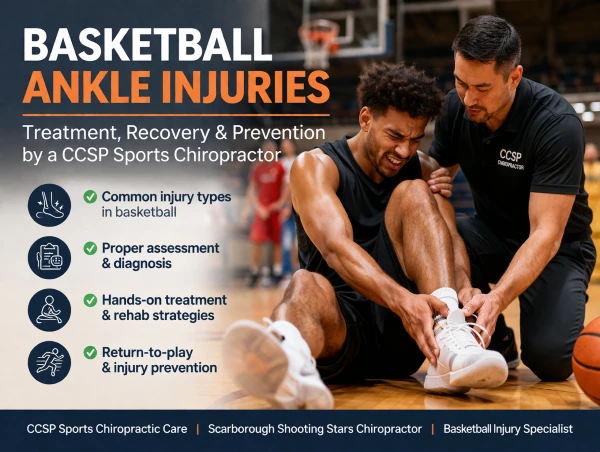
Basketball is a sport built on explosive movement. Players cut, accelerate, jump, land, pivot, and absorb contact dozens of times every game. That combination makes ankle injuries one of the most common problems I see in my practice, whether I am working with a youth athlete just starting out or a professional player competing at the highest level. As a Certified Chiropractic Sports Practitioner and the chiropractor for the Scarborough Shooting Stars, ankle sprains are something I treat almost every week.
Sports Chiropractor Toronto: Dr Ken Nakamura – Scarborough Shooting Stars Chiropractor
What concerns me most is not the injury itself. It is the attitude many athletes bring to it.
“It is just a sprain.” That phrase has kept more players sidelined longer than almost any other mindset in sports. A player feels the swelling go down, decides they are fine, and returns to practice before their ankle is actually ready. Weeks later they are back with the same injury, or worse, a new one in the knee or hip because their body was compensating without them knowing it. Proper assessment and sports focused treatment are not just about pain relief. They are about getting the whole ankle back to full function so the athlete can return to the court safely and stay there.
Why Basketball Is So Hard on Ankles
The ankle takes an enormous amount of punishment in basketball. Players jump and land repeatedly, often in traffic, sometimes on another player’s foot. They plant hard to change direction, decelerate at full speed, and react in milliseconds to plays they did not see coming. Even a small misstep in any of those moments can cause the ankle to roll.
The most common injury is the lateral ankle sprain, which happens when the foot rolls inward. This puts sudden stress on the ligaments on the outside of the ankle, especially the anterior talofibular ligament. Some of these sprains are mild and recover quickly. Others come with significant swelling, bruising, instability, and an inability to put weight on the foot.
But basketball ankle injuries are not always simple sprains. I also regularly assess and treat high ankle sprains, chronic ankle instability, peroneal tendon irritation, Achilles overload, joint restriction from old sprains that were never fully rehabilitated, and compensation patterns that have worked their way up into the knee, hip, or lower back. When symptoms are serious or persistent, imaging or medical referral may be necessary to rule out fractures or tendon ruptures. That is part of a thorough sports medicine approach.
What Athletes Feel, and What They Often Ignore
The obvious symptoms are easy to recognize. Pain on the inside or outside of the ankle, swelling, bruising, and difficulty walking are hard to miss. What athletes tend to downplay is the subtler stuff. A feeling that the ankle is not quite right even weeks after the injury. Hesitation when landing or cutting. A reduced ability to push off with the same confidence or power as before.
Run Pain-Free: How A Toronto Chiropractor Treats Common Running Injuries
Those subtle signs matter. They often mean the ankle has not fully recovered its mobility, strength, or proprioception, which is the body’s ability to sense where the joint is in space. When those gaps remain, the athlete is already set up for the next injury.
Why the First Sprain Often Leads to the Second
One of the patterns I see most often in basketball players is recurrent ankle sprains. The first injury does not fully heal, movement quality drops, and then the same ankle rolls again under the demands of live play. This is not bad luck. It is almost always the result of returning to sport before the ankle was truly ready.
After a sprain, the body compensates. The athlete unconsciously avoids loading the injured side properly. They lose range of motion in the ankle, particularly the forward movement of the knee over the foot known as dorsiflexion. They shift more stress onto the knee or hip without realizing it. Their balance and foot control become less reliable, especially under fatigue.
Pain going away is not the same as the problem being solved. A basketball player may feel good enough to practice but still have meaningful deficits in single leg stability, lateral movement mechanics, jump landing control, and push off power. Those deficits are what drive recurrent injury.
How I Assess a Basketball Ankle Injury
A proper sports assessment looks at far more than the ankle itself. When a player comes into my office, I want to understand the mechanism of injury, what structures are likely involved, how the ankle is moving, and how that ankle is affecting everything above it.
Assessment begins with swelling, bruising, and the athlete’s ability to bear weight comfortably. Joint mobility is tested to determine how much dorsiflexion has been lost. The ligaments and surrounding soft tissues are evaluated to clarify the type and severity of the injury. Balance and proprioception are also assessed, since both are essential in basketball and often decline quickly after a sprain. Movement quality is observed through walking, squatting, lunging, and hopping. The foot, ankle, knee, hip, and lower back are then considered together, because basketball players do not compete through one joint alone. They move as an integrated system, and when one part is compromised, the rest of the body adapts, whether the athlete realizes it or not.
This is the foundation of sports chiropractic care. Not just treating the painful area, but understanding how that area fits into the full picture of the athlete’s movement and performance.
What Treatment Actually Looks Like
When the ankle is restricted after a sprain, the talocrural joint, subtalar joint, and midfoot can all lose normal motion. Joint mobilization or manipulation restores that motion, which directly improves the athlete’s ability to walk, squat, land, and push off. Soft tissue treatment addresses the muscles and tendons of the lower leg that often become tight, guarded, or overloaded in response to injury.
But the hands on work is only part of what I do. Rehabilitation exercise is critical. Balance training, calf strengthening, foot control work, hopping progressions, and lateral stabilization drills are what rebuild the ankle’s resilience. Proprioceptive retraining teaches the nervous system to reliably sense joint position again, which is one of the most important factors in preventing reinjury. Landing mechanics, deceleration patterns, and cutting strategy may all need to be retrained to reduce stress on the recovering ankle and protect the joints above it.
Athletic taping or bracing has a place in certain return to play situations, particularly when an athlete is resuming basketball specific movement before full stability has returned. Every plan is built around the individual player’s stage of healing, position, and what the sport will actually demand of them.
The Overlooked Importance of Dorsiflexion
Of all the things lost after an ankle sprain, dorsiflexion is the one that affects performance the most and gets addressed the least. Dorsiflexion is the ability of the ankle to allow the knee to move forward over the foot, and it is essential to almost every major movement in basketball.
When dorsiflexion is restricted, the athlete cannot squat as deep, cannot absorb landing forces as well, loads the knee more than the ankle should allow, compensates with foot pronation, and loses efficiency in acceleration and direction changes. The body will find the range of motion it needs somewhere, and that somewhere is usually the knee, the Achilles, the hip, or the lumbar spine.
Restoring dorsiflexion is not just about ankle comfort. It is about protecting the entire lower body and keeping the athlete’s mechanics clean under the pressure of competition.
When to Stop Playing and Get Assessed
Some players tape it and keep going, which works fine for minor irritation. But certain signs mean the ankle needs proper evaluation right away. These include an inability to bear weight, significant swelling or bruising, pain directly over the bone, a popping sensation at the time of injury, a feeling of persistent instability, repeated sprains on the same ankle, or symptoms that simply are not improving with time.
These are not situations where rest alone is a reliable strategy. Early intervention changes recovery timelines and long term outcomes significantly.
What Real Return to Play Looks Like
Returning to basketball should not be based on how much pain the player has. Low pain is not the same as being ready for live play. A basketball athlete is ready to return when they can demonstrate full or nearly full ankle range of motion, solid single leg balance, the ability to hop, land, and cut without instability, confidence pushing off the injured side, and no significant compensation through the knee, hip, or trunk.
I have seen athletes who passed every static test fail the moment they had to react to an unpredictable situation in a drill. That is the real test. Basketball exposes every weakness, especially under fatigue and competitive pressure.
Building an Ankle That Does Not Break Down
Once a player has sprained an ankle, their risk of doing it again is genuinely higher unless the underlying issues are fully addressed. The most effective prevention is not wearing a brace, though bracing has its place. It is building a more resilient athlete through single leg balance training, foot and ankle strengthening, calf work, dorsiflexion mobility, landing and deceleration drills, and lateral movement control. Managing fatigue and monitoring how old injuries respond to increased load is part of the picture too.
Athletes, parents, and coaches often think of ankle sprains as minor events that just need time. The reality is that a sprain that is not rehabilitated properly becomes the foundation for the next injury, and the one after that.
Why Sports Specific Care Makes a Difference
An office worker with an ankle sprain and a basketball player have very different goals and very different demands. The basketball player needs to sprint, cut, jump, land, rotate, and react under pressure, often for 30 or 40 minutes of high intensity game time. General rehab does not always account for that.
As a CCSP who has worked with the Scarborough Shooting Stars, I focus on what the sport actually requires of the athlete’s body and build every treatment plan around getting them back to those demands safely and completely. An ankle sprain can seem like a small setback. Without proper care, it often becomes a chronic problem that limits explosiveness, erodes confidence, and affects how the entire body moves. With the right approach, most athletes recover fully and come back more durable than they were before.
If you are a basketball player dealing with ankle pain, repeated sprains, or lingering instability after a previous injury, a thorough sports medicine assessment can identify what has been missed, restore your function, and help you return to the court with real confidence.
Dr. Ken Nakamura, DC, CCSP is a Toronto sports chiropractor and Certified Chiropractic Sports Practitioner who treats athletes from recreational to elite level. He has served as chiropractor for the Scarborough Shooting Stars of the Canadian Elite Basketball League and has extensive experience treating basketball injuries, ankle sprains, running injuries, spinal conditions, TMJ disorders, and sports related performance issues.
Please follow and like us:


Dr. Ken, has been recognized as the Best Toronto Chiropractor in 2024, 2023, and 2018, here in downtown Toronto. As a sports chiropractor, he excels in treating a wide range of conditions including concussions, temporomandibular joint disorders (TMJ), sports-related injuries, and spinal issues. Beyond his clinical skills, Dr. Ken is an accomplished athlete, having represented Ontario in the Canadian Judo Championships and completed the Toronto Marathon on two occasions. He employs the innovative C3 Program to provide targeted and effective care to his patients, ensuring a holistic approach to their well-being and athletic performance.