Bodi Empowerment
Concussion //
Concussion Symptoms That Don’t Show up on MRI or CT
Please follow and like us:


Understanding why concussion symptoms can last for weeks or months — even when your MRI or CT scan shows nothing wrong.
Imagine this: A teenage hockey player takes a hard hit to the boards. She sits out the rest of the game, sees a doctor the next day, and gets a CT scan. The doctor comes back with what sounds like good news — “Everything looks normal.” But two months later, she still gets blinding headaches when she stares at her laptop. Bright lights make her feel sick. She can’t concentrate in class, and she cries more than she used to. Nothing looks wrong on paper. But something is clearly very wrong.
Why Dizziness After a Concussion May Come From Your Brain, Your Neck — or Both
This is one of the most confusing and frustrating parts of a concussion. Patients and parents are told the scan is “clean,” and they assume that means the brain is healed. But that’s not how concussions work — and understanding why can make a huge difference in your recovery.
Why a “Normal” Brain Scan Doesn’t Mean You’re Fine
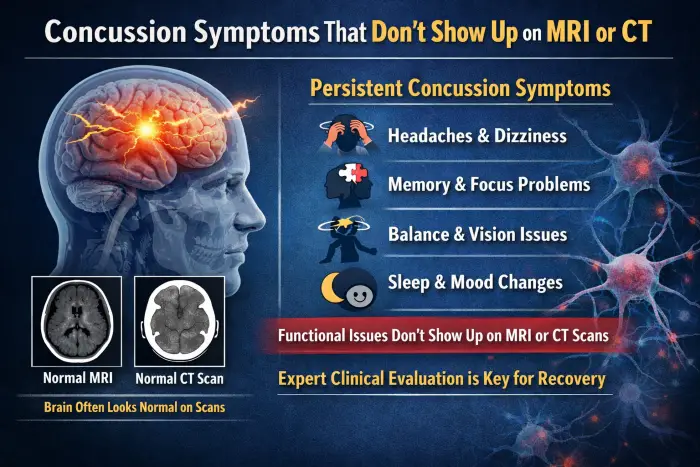
CT scans and MRIs are powerful tools. They’re great at spotting serious problems like bleeding in the brain, skull fractures, or tumors. But a concussion, also called a mild traumatic brain injury (mTBI) usually doesn’t cause that kind of visible damage. Instead, it causes tiny, microscopic changes in how your brain cells work.
Think of it like this: if a power outage hits your neighbourhood, the houses don’t fall down. The structures look perfectly fine. But nothing works. That’s what a concussion does to the brain. After a hit to the head, your brain goes through a kind of energy crisis, nerve signals get scrambled, brain cells temporarily run out of fuel, blood flow changes in certain areas, and inflammation builds up at a microscopic level that no scanner can see.
Best Concussion Treatment Options
So when the radiologist says your MRI is normal, they’re telling the truth. It just doesn’t tell the whole story.
What Persistent Concussion Symptoms Actually Feel Like
No two concussions are exactly alike, which is part of what makes them so tricky. Some people recover quickly. Others deal with symptoms for weeks or even months — a condition known as post-concussion syndrome. These symptoms usually fall into a few main areas.
Physical symptoms include headaches or a constant feeling of pressure in the head, dizziness and trouble keeping your balance, sensitivity to bright lights or loud sounds, blurry or double vision, and nausea.
Concussion Recovery: A Sports Chiropractor’s Guide for Safe Return to Play
Thinking and memory symptoms include brain fog (that feeling like your thoughts are moving through thick mud), difficulty concentrating or following a conversation, slower reaction time, forgetting things you normally wouldn’t, and feeling mentally exhausted after simple tasks.
Emotional and sleep symptoms include feeling more irritable or emotional than usual, anxiety or low mood, trouble falling asleep, and waking up still feeling tired even after a full night’s rest.
These symptoms happen because the brain controls almost everything your body does. When it’s struggling, the effects ripple through your entire life.
Why Some Concussions Take Much Longer to Heal
Most people recover from a concussion within 10 to 14 days. Young athletes may take up to four weeks. But for some people, symptoms drag on and on. Why? It often comes down to which systems in the body were disrupted — and whether those systems are getting the right kind of help.
Your neck may be the hidden culprit. Here’s something most people don’t know: a large number of concussion symptoms actually come from the neck, not the brain. The cervical spine — the bones and muscles in your neck — shares nerve pathways with the systems that control your balance and your head pain. When your head gets hit, your neck gets whipped around too. This can cause joint stiffness, muscle tension, and changes in how your neck sends signals to the brain. The result? Headaches, dizziness, and balance problems that look exactly like brain symptoms — but are actually coming from the neck.
Your balance system is out of sync. Deep inside your ears is your vestibular system — the body’s built-in gyroscope. It tells your brain where you are in space and helps you stay upright. Concussions frequently knock this system off balance, leading to dizziness, vertigo, and sensitivity to movement. This is why some concussion patients feel nauseated in cars or while scrolling on their phones.
Your eyes are working too hard. Your brain coordinates your eye movements dozens of times per second. After a concussion, this process can become exhausting and inaccurate. You might find it hard to track a moving object, struggle to read without getting a headache, or notice that screens bother you far more than they used to.
Going back too soon makes things worse. One of the biggest mistakes athletes make is trying to tough it out and push through symptoms. But returning to sport before the brain has healed is like running a marathon on a sprained ankle — it makes the injury worse and recovery longer.
What a Proper Concussion Assessment Actually Looks Like
Since a brain scan can’t tell the whole story, a skilled clinician has to do the detective work. A thorough concussion assessment goes far beyond shining a light in your eyes and asking what day it is. It should cover all the systems that a concussion can affect.
Neurological testing checks your coordination, reaction time, balance, and cranial nerve function — revealing problems that a brain scan simply can’t detect.
A cervical spine exam is a hands-on assessment of the neck that looks at joint mobility, muscle tightness, and posture. Many patients are surprised to find that neck treatment alone dramatically reduces their headaches and dizziness.
Vestibular and vision testing assesses how well your eyes track moving objects, how you handle head movement, and how stable your balance is. This kind of testing often reveals the exact source of symptoms that have been dismissed as “just stress” or “just anxiety.”
How Persistent Concussion Symptoms Are Treated Today
The old advice for concussions was simple: go lie in a dark room, rest, and wait. We now know that approach can actually slow recovery. Modern concussion care is active, targeted, and guided by which systems are affected.
Neck treatment — Manual therapy, gentle mobilization, and muscle release techniques can dramatically reduce headaches and dizziness that originate from the cervical spine. For many patients, this is the missing piece they’ve been looking for.
Vestibular rehabilitation — Specific exercises retrain the brain’s balance system. They can feel uncomfortable at first, but they signal the brain to adapt and recalibrate — and the results can be remarkable.
Vision therapy — Eye-tracking exercises help restore smooth communication between your eyes and brain, helping patients finally get back to reading, screen time, and normal daily life.
Graded aerobic exercise — Research has shown that carefully controlled cardiovascular exercise, starting well below the point where symptoms appear, actually speeds up recovery. It improves blood flow to the brain and helps resolve the metabolic crisis faster. This is one of the most important advances in concussion science in recent years.
When Should You Seek Help?
If symptoms haven’t improved after 10 to 14 days, don’t wait. Seek evaluation from a clinician who specializes in concussion management — especially if you’re experiencing headaches that keep getting worse, persistent dizziness, ongoing difficulty concentrating, deep fatigue that rest doesn’t fix, or symptoms that flare up with any physical activity.
And if you’re an athlete, do not return to sport while you are still having symptoms. The risk of a second concussion before the brain has healed is not worth it. The consequences can be severe and long-lasting.
The Bottom Line: Normal Scan, Real Symptoms — And Real Solutions
Going back to our hockey player from the beginning her scan was normal because there was no blood, no fracture, no tumor. But her brain was in the middle of a functional crisis, her neck was locked up, her vestibular system was off, and her visual system was overworked. None of that shows up on a scan. All of it shows up in a proper clinical assessment.
Concussions are complex injuries involving multiple interconnected systems in the brain and body. Recovery isn’t just about waiting — it’s about getting the right assessment from someone who understands what they’re looking for, and following a treatment plan that actually addresses what’s wrong.
If you or someone you love is still struggling after a concussion, know this: a normal scan does not mean there’s nothing wrong, and it does not mean there’s nothing that can be done. The right help exists. You just need a clinician who knows where to look.
Please follow and like us:


Dr. Ken, has been recognized as the Best Toronto Chiropractor in 2024, 2023, and 2018, here in downtown Toronto. As a sports chiropractor, he excels in treating a wide range of conditions including concussions, temporomandibular joint disorders (TMJ), sports-related injuries, and spinal issues. Beyond his clinical skills, Dr. Ken is an accomplished athlete, having represented Ontario in the Canadian Judo Championships and completed the Toronto Marathon on two occasions. He employs the innovative C3 Program to provide targeted and effective care to his patients, ensuring a holistic approach to their well-being and athletic performance.