Bodi Empowerment
Jaw Clicking, TMD, and When to Seek TMD Treatment
Please follow and like us:


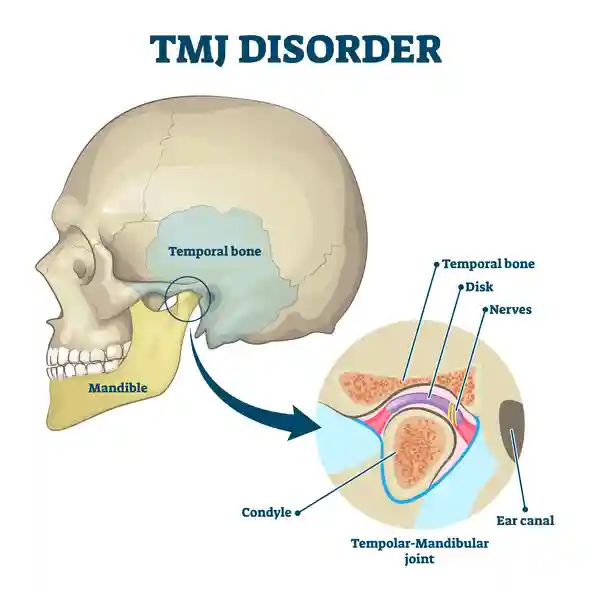
Jaw clicking is one of the most common concerns people have about their temporomandibular joints (TMJs). Sometimes it’s nothing more than a harmless noise. Other times, it’s an early sign of a temporomandibular disorder (TMD) that deserves professional attention.
One of the most useful clues is when the click happens—during opening, closing, or side‑to‑side movement. These patterns can help you form a reasonable working understanding of what might be going on before you see a clinician for TMD.
This article breaks down the different types of clicking, what they may indicate, and a simple exercise that can support early self‑care for TMD.
Understanding TMJ Disorder: Causes, Symptoms, and Treatment
🔍 Why Jaw Clicking Happens
The TMJ is a hinge‑and‑glide joint with a small disc that cushions movement. Clicking usually occurs when the disc is not moving smoothly with the jaw. This can happen for many reasons—muscle tension, joint irritation, habitual clenching, or changes in how the disc moves.
Understanding the timing of the click helps narrow down the possibilities.

1. Clicking on Opening: TMD
A click that occurs early in opening—often within the first 10–20 mm—may suggest that the disc is slightly forward and snaps back into place as the jaw begins to open.
A click that occurs mid‑opening may indicate that the disc is recapturing later in the movement, often associated with more noticeable deviation or “wiggle” in the jaw path.
A click that occurs near full opening is less common and may relate to joint strain or hypermobility (too much movement) rather than disc displacement.
What this pattern may suggest about TMD
- Early opening click → disc displacement with early reduction
- Mid‑opening click → disc displacement with later reduction
- Late opening click → joint laxity or muscle imbalance
These are not diagnoses—just patterns that help guide what to look for.
2. Clicking on Closing
A closing click often means the disc is slipping forward again as the jaw returns to rest.
What this pattern may suggest
- Closing click → disc reducing on opening but displacing again on closing
- Closing click with deviation → muscle imbalance or disc instability
A closing click is often paired with an opening click, forming a “double click” pattern.
3. Clicking During Lateral (Side‑to‑Side) Movements
Lateral movement is more complex than most people realize. The jaw doesn’t simply slide sideways—it rotates, glides, and shifts in a coordinated sequence.
How the jaw moves laterally
- Beginning of opening: slight lateral shift is normal as the jaw finds its path
- Mid‑opening: the jaw should center itself
- End of opening: the jaw may shift again depending on muscle tension or joint mechanics
Clicking during lateral movement may indicate: TMD
- The disc is unstable and shifts position as the jaw moves sideways
- One side of the jaw is working harder than the other
- Muscles on one side are tighter or overactive
If clicking happens only during lateral movement, it may be more muscle‑related than disc‑related.
4. Putting the Patterns Together: A “Best‑Guess” Working Understanding
While only a trained clinician can diagnose TMD, you can form a reasonable working understanding by observing:
✔ When does the click occur?
Opening, closing, or lateral movement?
✔ Where in the movement does it occur?
Beginning, middle, or end?
✔ Is there pain?
Pain changes the urgency.
✔ Is the click getting louder, more frequent, or harder to reproduce?
Changes over time matter.
✔ Does the jaw deviate or shift?
This can indicate muscle imbalance or disc movement.
A simple pattern guide
| Clicking Pattern | Possible Interpretation (Not a Diagnosis) |
|---|---|
| Early opening click | Disc displacement with early reduction |
| Mid‑opening click | Disc displacement with later reduction |
| Opening + closing click | Disc reducing then displacing again |
| Lateral‑only clicking | Muscle imbalance or mild disc instability |
| Clicking with pain | Joint irritation or inflammation |
If clicking is painful, progressively worsening, or affecting chewing, it’s time for a professional evaluation.
5. A Helpful Exercise: Controlled Opening With Tongue‑Up Position
This exercise supports smoother jaw mechanics and reduces strain on the joint.
Tongue‑Up Controlled Opening
- Place the tip of your tongue on the roof of your mouth, just behind your front teeth.
- Keep your teeth slightly apart.
- Slowly open your mouth without letting your tongue lose contact with the palate.
- Stop before the tongue lifts off.
- Close gently and repeat 8–10 times.
Why this helps TMD
- Encourages proper jaw tracking
- Reduces excessive forward translation of the joint
- Helps calm overactive muscles
- Promotes smoother disc movement
This exercise is gentle and safe for most people, but it’s not a substitute for individualized care.
When to Seek Professional Help For TMD
A clinician such as a Chiropractor or dentist familiar with TMJ issues, can help if:
- The clicking is painful
- The jaw locks or feels unstable
- The clicking is getting worse
- You have headaches, ear symptoms, or facial tension
- You avoid certain foods because of discomfort
Early assessment can prevent small issues from becoming bigger ones.
Perform 5–10 repetitions, 2–3 times per day, provided there is no increase in pain, clicking, or locking.
If clicking persists despite limiting range, or if pain or locking develops, discontinue the exercise and seek in-person evaluation. Long-term TMD treatment may also include education, temporary dietary modification, stress and clenching management, posture correction, and—when indicated—splints or targeted physiotherapy.
Tell us what you think in the comments below and like us on Facebook. This Toronto Downtown Chiropractor will answer all questions in the comments section.
Please follow and like us:


Dr. Ken, has been recognized as the Best Toronto Chiropractor in 2024, 2023, and 2018, here in downtown Toronto. As a sports chiropractor, he excels in treating a wide range of conditions including concussions, temporomandibular joint disorders (TMJ), sports-related injuries, and spinal issues. Beyond his clinical skills, Dr. Ken is an accomplished athlete, having represented Ontario in the Canadian Judo Championships and completed the Toronto Marathon on two occasions. He employs the innovative C3 Program to provide targeted and effective care to his patients, ensuring a holistic approach to their well-being and athletic performance.