Bodi Empowerment
Balance Problems After a Concussion: Causes, Symptoms, and Recovery
Please follow and like us:


Balance problems after a concussion are more common than most people realize, and for many patients, they are also the most disorienting part of the recovery process. You stand up too fast, and the room tilts. You walk through a busy grocery store, and your body feels like it cannot keep up with what your eyes are seeing. You turn your head to check traffic before crossing the street, and for just a moment, the world seems to spin.
If these balance problems sound familiar after a head injury, you are not imagining it, and you are not alone.
Concussion Symptoms That Don’t Show up on MRI or CT
Many patients describe feeling unsteady, dizzy, or off balance even weeks after the initial injury, long after the headaches have faded and the fogginess has lifted. What most people do not realize is that balance problems after a concussion have a clear, measurable explanation, and they respond well to the right kind of treatment.
Why Concussions Disrupt Your Sense of Balance
To understand why balance problems develop after a concussion, it helps to understand how balance works in the first place.
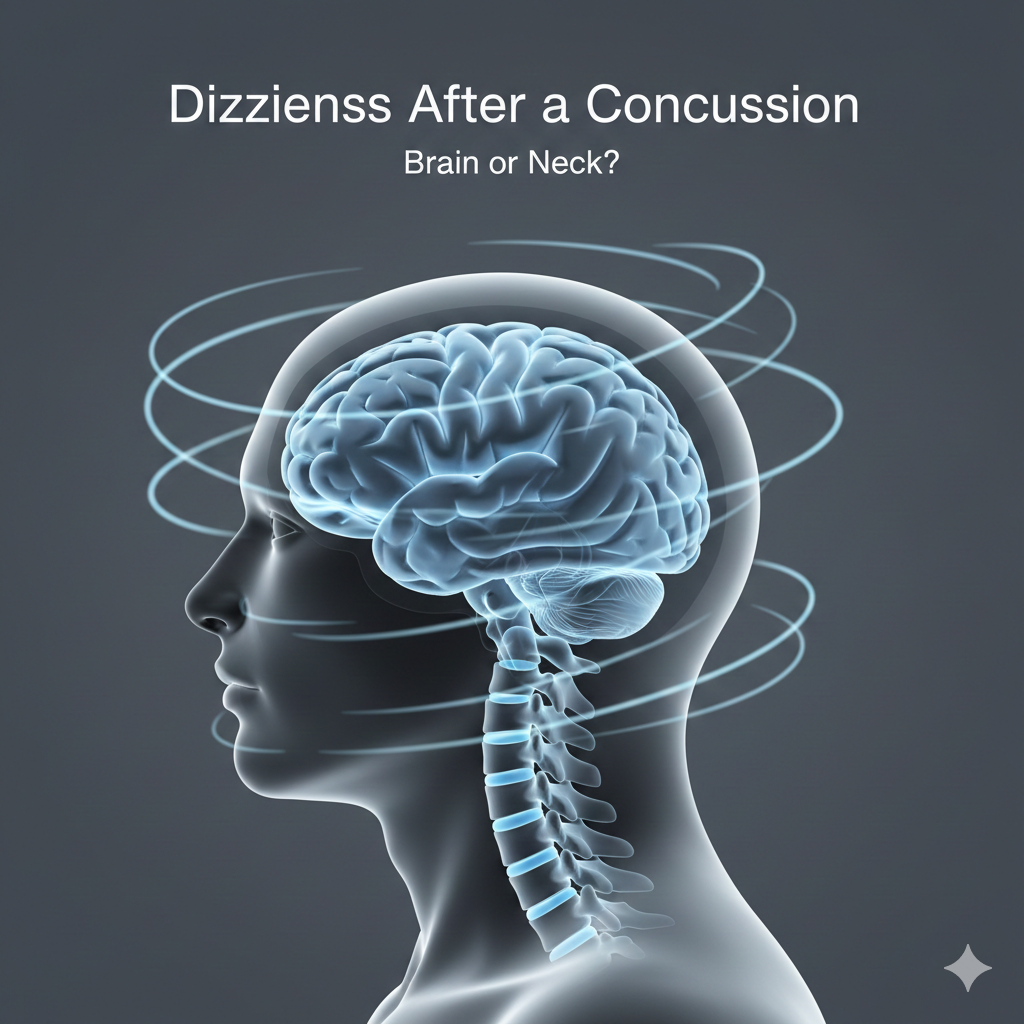
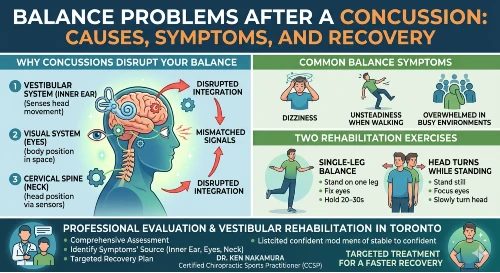
Your brain is constantly receiving information from three different systems at once. The vestibular system, which lives in the inner ear, detects head movement and tells the brain how your head is positioned and how fast it is moving. The visual system, meaning your eyes, helps the brain figure out where your body is in space. The cervical spine, which is the upper part of your neck, contains tiny sensors called proprioceptors; these sensors send signals to the brain about the angle and position of your head relative to the rest of your body.
Under normal circumstances, these three systems work together so seamlessly that you never think about them. You walk, you turn, you reach, and your brain quietly integrates all of that incoming information into a smooth, effortless sense of stability.
Recovering from Post Concussion Syndrome: Step-by-Step Guide
A concussion disrupts that integration. The brain takes a mechanical hit, and the connections between these systems become temporarily disorganized. The signals coming in from the inner ear, the eyes, and the neck no longer line up the way they should. The brain, trying to make sense of conflicting information, produces the balance problems patients describe, including dizziness, instability, and motion sickness.
Think of it like three musicians in a band suddenly losing their ability to hear each other. Each one keeps playing, but without coordination, the result is noise instead of music.
The Three Body Systems That Control Balance
The Vestibular System (Inner Ear)
The vestibular organs inside the inner ear are the brain’s primary source of information about head movement and acceleration. Every time you nod, turn, or tilt your head, these organs fire signals to the brain describing exactly what is happening and how quickly.
After a concussion, those signals can become distorted or misread. The brain receives information that does not match what the eyes and neck are reporting, and the result is dizziness, vertigo, or the kind of persistent balance problems that seem to come from nowhere and have no obvious trigger.
The Visual System
The eyes do more than just see. They also help the brain anchor the body in space, giving a continuous visual reference for where you are and how you are moving. After a concussion, eye movement control is often affected; patients may notice difficulty focusing, trouble tracking moving objects, or a feeling that their vision cannot keep up with their movements.
When the visual system is not feeding the brain clean, stable information, balance problems worsen, particularly in environments with a lot of visual movement, like busy streets, scrolling screens, or crowded rooms.
The Cervical Spine and Neck Proprioception
The neck is a critical and often overlooked part of the balance equation. The joints and muscles of the cervical spine are packed with proprioceptive receptors, small sensory structures that continuously tell the brain where the head is positioned relative to the body.
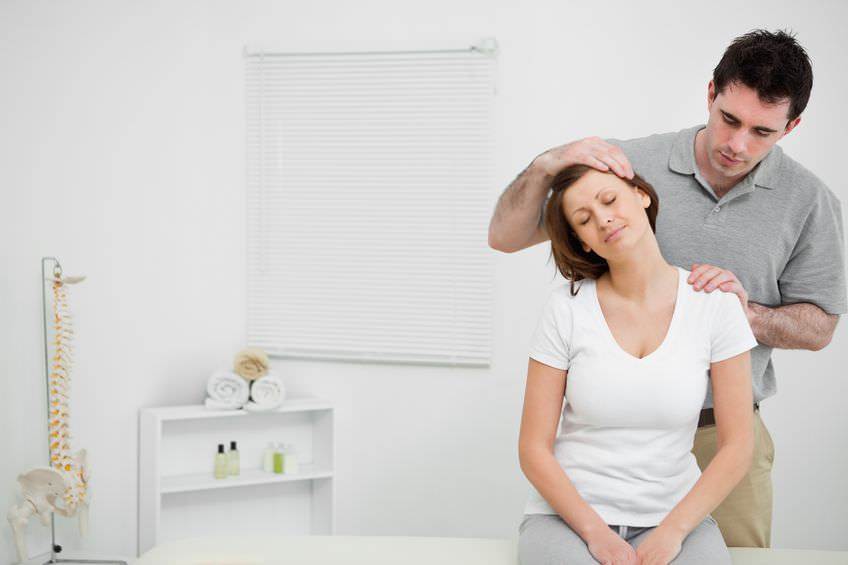
Following a head injury, the cervical spine frequently develops joint restrictions, muscular tension, or soft tissue irritation. Any of these can interfere with proprioceptive signaling, adding another layer of conflicting information for the brain to process. When all three systems are sending mismatched signals at the same time, the body loses its stable reference point, and balance problems follow.
Common Balance Symptoms After a Concussion
Balance problems after a concussion can show up in a variety of ways, and no two patients experience them exactly the same. Some people feel unsteady when walking on uneven ground or up and down stairs. Others notice that turning their head quickly brings on dizziness, or that busy visual environments like grocery stores, shopping malls, and intersections feel overwhelming in a way they never did before.
Some patients report a floating or “off” sensation when standing still, as if the floor beneath them is subtly shifting. Others struggle with quick changes in direction, or find that looking at moving objects, like passing cars or scrolling on a phone, triggers nausea or disorientation.
The most commonly reported balance problems include feeling unsteady when walking, dizziness when turning the head, motion sensitivity in visually busy environments, difficulty with quick or unexpected movements, and a persistent feeling of being off balance even when standing still.
These balance problems are particularly common in patients with persistent concussion symptoms and post-concussion syndrome, which refers to concussion effects that continue beyond the typical two to four week recovery window. It is worth knowing that these symptoms are not a sign of permanent damage. They are signs that the brain’s balance processing systems need rehabilitation, which is exactly what vestibular therapy is designed to provide.
Two Vestibular Rehabilitation Exercises for Concussion Recovery
Vestibular rehabilitation uses specific, graduated movements to help the brain recalibrate its balance systems. The goal is not to push through discomfort but to gently challenge the brain in a controlled way so that its processing improves over time, and balance problems gradually reduce.
Here are two exercises commonly used in concussion recovery that may support rehabilitation.
Exercise 1: Single-Leg Balance
Stand upright near a wall or sturdy chair, close enough to catch yourself if needed. Lift one foot a few inches off the ground and balance on the other leg. Fix your eyes on a single point directly in front of you, a spot on the wall works well, and hold the position for 20 to 30 seconds. Repeat 3 to 5 times on each leg.
This exercise works because it forces the vestibular system, the visual system, and the stability muscles in your lower body to coordinate simultaneously. When these systems practice working together in a controlled setting, the brain gradually becomes better at integrating their signals, which directly addresses the root cause of balance problems after a concussion.
Exercise 2: Head Turns While Standing
Stand with your feet shoulder-width apart and your eyes focused on a fixed point in front of you. Slowly turn your head left and then right, keeping your body still and your gaze anchored to that same point. Continue for 30 seconds, then rest, and perform 3 sets.
This exercise directly challenges the vestibular system by introducing head movement while the rest of the body stays stable. Head movement is one of the most reliable triggers for balance problems after a concussion; this exercise teaches the brain to process that movement without losing its sense of orientation.
Both exercises should be introduced gradually. If balance problems increase significantly during or after either exercise, that is a signal to reduce the difficulty and consult a clinician before continuing.
When Balance Problems After a Concussion Need Professional Care
If balance problems are present beyond 10 to 14 days after a concussion, a professional evaluation is the appropriate next step. Persistent dizziness and instability are not symptoms to wait out indefinitely; they suggest that one or more of the three balance systems is not recovering on its own and needs targeted clinical support.
A comprehensive concussion assessment can identify whether the vestibular system in the inner ear is the primary driver of balance problems, whether the cervical spine is contributing through joint restriction or muscular tension, or whether visual tracking problems are making it harder for the brain to stabilize its sense of position during movement.
Each of these sources requires a different clinical approach, which is why accurate diagnosis matters. Treating only one component when all three are involved will produce incomplete and often frustrating results. Patients who have been told to simply rest and wait frequently find that their balance problems persist until the underlying system disruptions are directly addressed.
Concussion Assessment and Vestibular Rehabilitation in Toronto
Balance problems after a concussion are rarely a single-system issue. The brain, the inner ear, the eyes, and the cervical spine are all part of the story, and full recovery depends on evaluating and addressing all of them together.
Dr. Ken Nakamura is a Certified Chiropractic Sports Practitioner (CCSP) in Toronto with clinical experience in concussion assessment and rehabilitation. His approach includes neurological testing, cervical spine evaluation, and movement analysis to identify the specific sources of a patient’s balance problems and build a structured recovery plan.
Whether the goal is returning to sport, getting back to work, or simply feeling stable walking down the street again, targeted treatment makes that process faster and more complete than rest alone.
If balance problems after a concussion are affecting your daily life, a thorough assessment is the right place to start.
Please follow and like us:
Dr. Ken, has been recognized as the Best Toronto Chiropractor in 2024, 2023, and 2018, here in downtown Toronto. As a sports chiropractor, he excels in treating a wide range of conditions including concussions, temporomandibular joint disorders (TMJ), sports-related injuries, and spinal issues. Beyond his clinical skills, Dr. Ken is an accomplished athlete, having represented Ontario in the Canadian Judo Championships and completed the Toronto Marathon on two occasions. He employs the innovative C3 Program to provide targeted and effective care to his patients, ensuring a holistic approach to their well-being and athletic performance.