Bodi Empowerment
TMJ Clicking: When to Worry, What It Means, and How a Downtown Toronto Chiropractor Treats It
Please follow and like us:


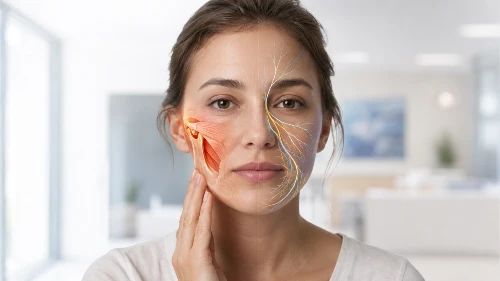
Does your jaw click when you open your mouth?
Maybe it happens when you yawn. Maybe it clicks when you chew. Maybe it started as a small noise, but now your jaw feels tight, sore, or stuck.
If that sounds like you, you are not alone. TMJ, TMD, or TMJD can affect the jaw joint, the muscles around the jaw, or both. Clicking is one of the most common signs patients notice first.
The good news? A clicking jaw does not always mean something serious is happening.
The bad news? If the clicking comes with pain, locking, headaches, neck pain, or trouble opening your mouth, your jaw is telling you that something is not moving properly.
In this issue of Bodi Empowerment, we’ll explain what TMJ clicking means, when you should worry, and how a downtown Toronto chiropractor may help.
What Is The TMJ?
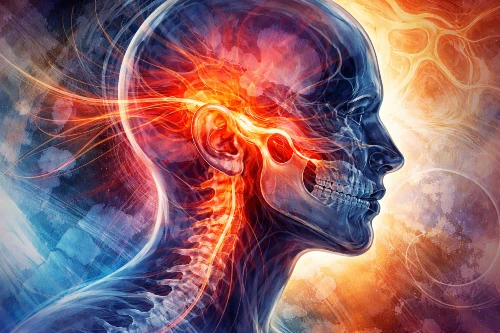
TMJ stands for temporomandibular joint. That is the jaw joint just in front of your ear.
You use this joint every time you talk, chew, yawn, sing, laugh, or bite your food. It is one of the most used joints in your body.
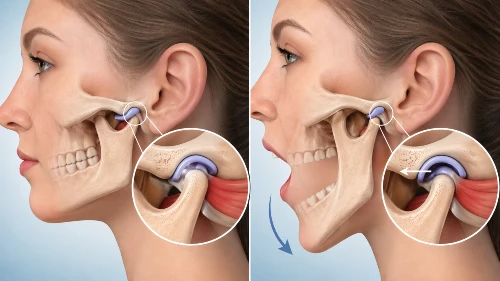
Inside the TMJ is a small disc. Think of it like a cushion that helps your jaw glide smoothly when you open and close your mouth.
When everything works well, your jaw opens and closes quietly. When the disc does not move well, you may hear or feel a click.
For a deeper explanation of jaw clicking patterns, you can read TMJ Clicking: What It Really Means.
What TMJ Clicking Actually Means
Your TMJ has a small disc that sits between the jawbone and the skull. When you open your mouth, this disc should glide with the jaw.
A click often means the disc is sliding forward and then snapping back as the jaw opens or closes.
Here is a simple way to picture it.
Imagine a drawer sliding on a track. If the track is smooth, the drawer opens without noise. If the drawer shifts off track for a second, it may clunk, catch, or snap.
That is similar to what can happen with your jaw.
The click is not the real problem. The click is a sign that the joint, disc, muscles, or jaw control may need attention.
Is Jaw Clicking Always Bad?
No. A painless click is not always an emergency.
Some people have jaw clicking for years without pain or loss of function. If your jaw opens fully, does not lock, and does not hurt, you may only need to monitor it.
But clicking should not be ignored if symptoms are getting worse.
Think of it like a warning light on your dashboard. The car may still drive, but the signal is worth checking before the problem grows.
When Should You Worry About TMJ Clicking?
You should consider getting your jaw assessed if your clicking comes with any of these signs.
1. Pain With Chewing
Pain when chewing steak, bagels, gum, or crunchy foods can mean your jaw muscles or joint are irritated.
This often happens when the jaw is overloaded by clenching, grinding, stress, or trauma.
If jaw pain is becoming a daily issue, read more about TMJ treatment and jaw pain.
2. Jaw Locking
If your jaw gets stuck open or closed, the disc may not be gliding well.
A locked jaw can be scary. Even if it unlocks on its own, it is a sign that your jaw mechanics need help.
3. Limited Mouth Opening
Try this simple screen.
Place three fingers stacked vertically between your front teeth. Many people can fit about three fingers. If you can only fit one or two, or opening feels blocked, your TMJ may not be moving well.
Do not force this test. Stop if it causes pain.
4. Ear Pain Or Temple Pain
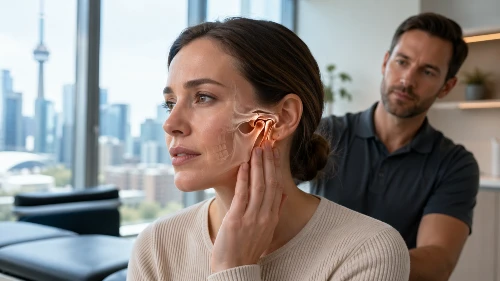
TMJ pain can feel like ear pain because the jaw joint sits close to the ear. Some people also feel pain around the temple, cheek, or side of the head.
5. Headaches With Jaw Tightness
Jaw tension can contribute to headaches, especially when combined with neck stiffness and stress.
This is why TMJ care often includes the jaw, neck, posture, and breathing habits rather than only the joint itself.
If you also struggle with neck stiffness, you may find this guide helpful: How To Improve Posture And Alleviate Neck Pain.
6. Clicking After A Sports Hit
Hockey, boxing, MMA, rugby, basketball, martial arts, and judo can all expose the jaw to direct or indirect impact.
If your clicking started after a hit, fall, whiplash-type motion, or concussion, get assessed.
TMJ symptoms can also happen with concussion symptoms. You can learn more here: Concussion Rehabilitation: How To Return To Sport.
Why Your Jaw Started Clicking
TMJ clicking usually does not happen for only one reason. It is often a mix of joint movement, muscle tension, habits, and stress.
Here are the most common causes I see.
Clenching And Grinding
Many people clench without knowing it.
You may clench while working, studying, driving, lifting weights, or sleeping. Over time, this can overload the jaw muscles and irritate the TMJ.
A common clue is waking up with jaw tightness, tooth sensitivity, or a dull headache.
Stress
Stress does not cause every TMJ problem, but it can turn the volume up.
When you are stressed, your shoulders rise, your neck tightens, your breathing changes, and your jaw may brace. That bracing can make clicking, pain, and tightness worse.
Neck Posture
Your jaw and neck work together.
If your head sits forward for long periods, the muscles under your jaw and around your neck can become overworked. This can change how your jaw tracks when you open and close.
For posture help, see How To Improve Posture: A Guide To Alleviate Neck Pain.
Sports Trauma
A hit to the jaw can strain the joint, disc, ligaments, or muscles.
Even a blow that does not land directly on the jaw can affect the TMJ if the head and neck are jolted. This matters even more when concussion symptoms are present.
For athletes, this article may also help: Why Toronto Athletes Choose Chiropractic Care for Peak Performance.
Dental Changes
New dental work, bite changes, missing teeth, or a nightguard that does not fit well may change how your jaw loads.
In those cases, a dentist should be part of your care team.
How A Downtown Toronto Chiropractor Assesses TMJ Clicking
A good TMJ assessment should not be a quick “open and close” check.
At Bodi Empowerment, the goal is to understand why your jaw is clicking and what is driving your symptoms.
A TMJ assessment may include:
Jaw Opening And Closing
Your chiropractor checks how far your jaw opens, whether it shifts to one side, and when the click happens.
A click at the start of opening may mean something different than a click near full opening.
Joint Motion
Your TMJ should glide smoothly. If one side moves less than the other, your jaw may shift, click, or feel blocked.
Muscle Tenderness
The jaw muscles can become very tender. This can include muscles on the cheek, temple, under the jaw, and sometimes inside the mouth.
Neck And Posture Check
Your neck can influence your jaw. That is why your assessment should include neck mobility, upper back posture, and shoulder position.
Sports And Concussion History
If the clicking started after a hit, fall, or concussion, that changes the plan.
Dr. Ken has a special interest in TMJ treatment, concussion care, sports injuries, acupuncture, dry needling, Active Release Technique, and rehabilitation exercise.
How Chiropractic Care May Help TMJ Clicking
The right treatment depends on the cause.
There is no one-size-fits-all answer. Some people need muscle work. Some need joint work. Some need exercises. Some need dental care. Many need a mix.
Here are treatment options that may help.
1. Soft Tissue Therapy
Tight jaw muscles can pull the jaw off track.
Soft tissue therapy may target the masseter, temporalis, pterygoids, neck muscles, and upper shoulders. This can reduce tension and help the jaw move with less strain.
2. Intra-Oral Muscle Release
Some jaw muscles are best accessed from inside the mouth.
This is done with gloves and patient consent. It can be helpful when deep jaw muscles are tight and contributing to clicking, pain, or limited opening.
For more on this type of care, read Chiropractic Solutions for Persistent TMD.
3. TMJ Mobilization
Gentle joint mobilization may help improve jaw glide.
This is different from forcing the jaw. The goal is better movement, not aggressive pressure.
4. Neck And Upper Back Treatment
Because the jaw and neck are connected, treating the neck can sometimes reduce TMJ stress.
This may include joint work, soft tissue therapy, posture correction, and mobility exercises.
5. Acupuncture Or Dry Needling
For some patients, acupuncture or dry needling may help reduce muscle tension and pain.
This can be useful when the jaw muscles, neck muscles, or headache patterns are part of the problem.
6. Jaw Exercises
Exercises help retrain the jaw so it opens smoothly.
The goal is not to stretch harder. The goal is control.
Many people make TMJ clicking worse by forcing the jaw open, chewing gum, or doing random online exercises that do not match their problem.
Gentle TMJ Exercises You Can Try
Try these only if they do not increase pain. Stop if your jaw locks, catches, or feels worse.
Controlled Opening
Sit tall. Place your tongue gently on the roof of your mouth, just behind your front teeth.
Slowly open your mouth a small amount while keeping your jaw centered.
Do 5 to 10 slow reps.
This teaches your jaw to open with better control.
Jaw Relaxation Position
Rest your tongue on the roof of your mouth.
Let your teeth stay slightly apart.
Let your lips close gently.
This is your jaw’s rest position. Use it during computer work, driving, and studying.
Mirror Opening
Stand in front of a mirror.
Open and close your mouth slowly while watching for jaw shifting.
Try to keep the jaw centered.
Do not force it straight. Use small, pain-free motion.
What To Avoid If Your TMJ Clicks
If your jaw is clicking and sore, avoid these for now:
Chewing gum
Biting nails
Chewing ice
Huge yawns
Very hard foods
Resting your chin on your hand
Pushing your jaw to “test” the click
Forcing your mouth open
Small changes can make a big difference. If your jaw is irritated, give it fewer reasons to complain.
When To See A Dentist, Doctor, Or Oral Surgeon
A chiropractor can help many TMJ problems, especially when the issue involves jaw movement, muscle tension, neck stiffness, posture, or sports trauma.
But some cases need dental or medical care.
See a dentist, doctor, or oral surgeon if you have:
New tooth pain
Major bite changes
Facial swelling
Fever
Jaw dislocation
Numbness
Severe trauma
Progressive locking
Unexplained weight loss
Pain that keeps getting worse
Good care means knowing when to treat and when to refer.
Why Choose A Downtown Toronto Chiropractor For TMJ Clicking?
TMJ problems are rarely only about the jaw.
Your neck, posture, stress, sleep, sports history, and daily habits can all play a role.
Dr. Ken Nakamura is a downtown Toronto chiropractor with a special interest in TMJ treatment, concussion care, and sports injuries.
His care may include chiropractic adjustments, soft tissue therapy, acupuncture, dry needling, Active Release Technique, rehabilitation exercises, custom orthotics, and exercise-based recovery plans.
You can learn more about his TMJ services here: TMJ Treatment in Toronto.
Should You Worry About TMJ Clicking?
A painless click that has not changed may not be urgent.
But if your jaw clicks with pain, locking, headaches, ear symptoms, or limited opening, it is time to get assessed.
Your jaw should open and close smoothly. If it does not, there is usually a reason.
The sooner you understand the cause, the easier it is to correct the pattern before it becomes a daily problem.
At Bodi Empowerment, the goal is simple: help you move better, feel better, and get back to chewing, speaking, training, and living without worrying about your jaw every day.
To book an assessment, visit Bodi Empowerment’s contact page.
Please follow and like us:

Dr. Ken, has been recognized as the Best Toronto Chiropractor in 2024, 2023, and 2018, here in downtown Toronto. As a sports chiropractor, he excels in treating a wide range of conditions including concussions, temporomandibular joint disorders (TMJ), sports-related injuries, and spinal issues. Beyond his clinical skills, Dr. Ken is an accomplished athlete, having represented Ontario in the Canadian Judo Championships and completed the Toronto Marathon on two occasions. He employs the innovative C3 Program to provide targeted and effective care to his patients, ensuring a holistic approach to their well-being and athletic performance.